Targets move in and out of fashion in drug development. Usually the enthusiasm shows up before the biology has earned it. TL1A in IBD is one of the cases where it ran the other way. The science got convincing first, and the money came chasing it. When Merck paid $10.8 billion for Prometheus Biosciences in 2023, it was not buying a product. It was buying a mechanism, and a wager that this one pathway does something the drugs we already have cannot. For a cell biologist, that is the interesting kind of bet. It rests on how a target actually works, not on a clever molecule.
The money moved first
Prometheus was the headline, not the whole story. Within months Roche paid roughly $7.1 billion for Telavant and its TL1A antibody, now called afimkibart (RVT-3101). Notably, that program had started life at Pfizer. Sanofi took duvakitug forward with Teva. AbbVie picked up Celsius Therapeutics. Spyre arrived with extended half-life antibodies built for twice-yearly dosing. So inside of a year, most of the big names in immunology had put real money behind a single ligand. Of course, you can argue about the valuations. It is harder to argue with the signal. When this many sophisticated buyers pile onto one target this fast, the biology has usually earned its credibility.
Analysts have since taken to calling the anti-TL1A class a “pipeline in a product.” Projected class sales run into the tens of billions. Blue-sky numbers reach $66 billion if it delivers across autoimmune disease. Still, set the forecasts aside for a second. The more useful question is why anyone believes them.
Then the clinic caught up
The reason is that the bets are starting to pay off in the clinic, which is where this kind of enthusiasm usually goes to die. Merck’s tulisokibart, once known as PRA023, hit its primary and key secondary endpoints in the Phase 3 ATLAS-UC study in ulcerative colitis. That is the first Phase 3 win for the class, and it counts for more than any deal. Duvakitug then added positive Phase 2b data its sponsors called best-in-class potential in both ulcerative colitis and Crohn’s disease. Afimkibart, meanwhile, cleared its own Phase 2b (TUSCANY-2). Results at that level turn a target from interesting into probable. They are also why physicians and patients finally have something concrete to be hopeful about.
A target that travels
Where the class is heading is almost as telling as the data. IBD is furthest along. Still, TL1A is being pushed into a dozen autoimmune conditions: rheumatoid and psoriatic arthritis, hidradenitis suppurativa, atopic dermatitis. It is even being tried in fibrotic disease outside the gut, including systemic sclerosis-associated interstitial lung disease, where the current options do little. In short, a target that travels that far usually has something fundamental underneath it.
Why TL1A in IBD does not behave like anti-TNF or JAK
So what is underneath it? This is the part I find most interesting, so let me get mechanistic.
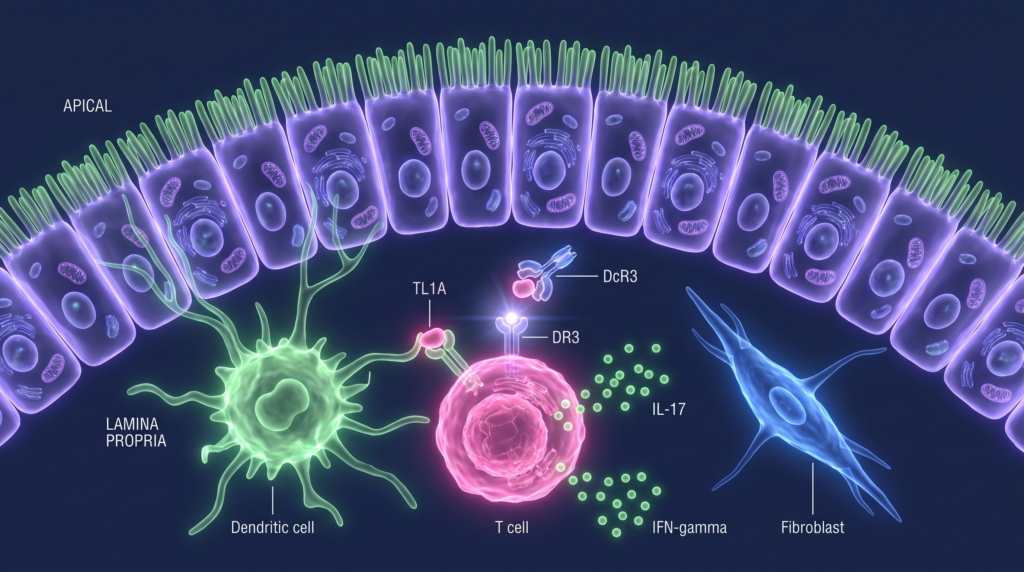
TL1A, the product of the gene TNFSF15, belongs to the TNF superfamily. Yet it does not act like TNF-alpha where it counts. It signals through DR3, and the whole axis is held in check by a soluble decoy receptor, DcR3. That decoy’s levels track disease activity right alongside TL1A, which tells you something on its own. This is a pathway the body already dials up and down on purpose, locally, at the site of inflammation.
Where the pieces sit
Where the pieces sit is the real tell. TL1A is made mostly by the mononuclear phagocytes that crowd inflamed mucosa, the CD11c-high, MHC-II positive dendritic cells and macrophages. Plasma cells, gut-homing lymphocytes, endothelium, and the intestinal myofibroblasts that matter later in this story pitch in too. DR3, the receptor, lives mostly on lymphocytes: effector CD4 and CD8 T cells once activated, regulatory T cells constitutively, innate lymphoid cells at high levels. So the ligand shows up where the fire is. The receptor sits on the cells that both stoke it and contain it. You are not switching off a signal that runs everywhere. Instead, you are quieting a conversation happening in one room.
An amplifier, not an initiator
That locality is the whole point of the pharmacology. TL1A does not start the immune response. Rather, it amplifies one already underway. Its loudest work comes under suboptimal stimulation, a fair description of the low, grinding inflammation of IBD. Engage DR3 and T cells pour out IL-2, interferon-gamma, IL-17, and IL-13, the effector programs that chew through tissue. Because TL1A sits upstream, blocking it turns several of those signals down together. It avoids the everywhere-at-once effect of neutralizing one cytokine across the body, or of damping a broad swath of intracellular signaling.
Against the workhorses
Set that against the workhorses and the appeal gets obvious. Anti-TNF neutralizes one dominant cytokine everywhere, a strategy that works beautifully until it doesn’t. In fact, about a third of patients never respond, and plenty who do eventually stop. JAK inhibitors, by contrast, reach inside the cell and block signaling shared by many cytokines at once. That buys oral dosing, at the cost of breadth and the boxed warnings that come with it. TL1A aims at a narrower, upstream node the body switches on selectively. The safety so far has looked clean, with no dose-limiting signals of the kind that box in JAK inhibitors. Still, I would want to see that hold across bigger and longer trials before calling it settled.
| Anti-TNF | JAK inhibitors | Anti-TL1A | |
|---|---|---|---|
| What it targets | A single effector cytokine (TNF-alpha) | Intracellular JAK-STAT signaling shared by many cytokines | An upstream costimulatory ligand (TL1A via DR3) |
| Where it acts | Systemic | Systemic, intracellular | Localized to active inflammation |
| Signals modulated | TNF-alpha | Many, broadly | TNF, IL-17, IFN-gamma and others, upstream |
| Fibrosis | Not directly addressed | Not directly addressed | Directly implicated, reversed in models |
| Genetic validation | Indirect | Indirect | TNFSF15 is a validated IBD risk gene |
| Key limitation today | About a third never respond, plus loss of response | Boxed safety warnings | Long-term clinical data still maturing |
The problem no current drug touches
Here is the part that should matter most to anyone treating the sickest patients. TL1A does not just inflame tissue. It scars it. Signaling through DR3 acts directly on intestinal fibroblasts. In animal models, anti-TL1A antibodies cooled the inflammation and reversed established fibrosis, even when given late. Sit with what that implies. Nothing we prescribe today does much for the strictures and scarring that eventually send Crohn’s patients into surgery. A mechanism that reaches both the inflammatory and the fibrotic side of the disease is a real departure. As a result, the class is now being tested in fibrosis well beyond the gut. It does not rest on a hunch, either. TNFSF15 shows up as an IBD risk gene in human genetics, about the strongest preclinical validation a target can carry.
From Monoclonals to bispecifics
Every TL1A program with Phase 3 data so far is a single antibody. The next race is already on, and it is about combinations. The pairing everyone is talking about is TL1A with IL-23, and the logic holds together well. IL-23 keeps the pathogenic Th17 program running, while TL1A costimulates effector T cells and drives fibrosis. So blocking both upstream nodes at once could push past the efficacy ceiling that single agents keep bumping into. Preclinical work supports the idea, with the dual approach outperforming either target alone.
For now, the interesting part is how differently the field is going about it.
| Program | Company | Targets | Angle |
|---|---|---|---|
| XmAb412 | Xencor | TL1A x IL-23p19 | Native-like 1+1 format to limit immune complexes |
| RO7837195 | Roche / Pfizer | TL1A x IL-23p40 | Big-pharma bispecific, Phase 2 in IBD |
| CLD-423 | Caldera | TL1A x IL-23p19 | Conditionally active design |
| SL-846 | Shattuck Labs | DR3 x IL-23R | Engages the TL1A receptor (DR3) rather than the ligand |
One problem hangs over all of it, and it is a good lesson in how much this mechanism still has to teach us: immunogenicity. Several early TL1A molecules, Amgen’s discontinued AMG966 among them, ran into anti-drug antibodies in nearly every patient. The cause turned out to be biological rather than technical. Drug and soluble target were forming immune complexes large enough to break tolerance, provoking a response against both the antibody and TL1A itself. That is not a formulation nuisance you quietly engineer around. Instead, it is why the newer entrants are so preoccupied with format and stoichiometry. The class’s real problem is a molecule that is potent, durable, and quiet on immunogenicity. That is harder than the pipeline slides make it look.
This is exactly where the biology gets hard to study, and where the model you choose stops being a detail. A signal that operates at the meeting point of immune cells, epithelium, and stroma cannot be read in a dish of any one cell type. Neither can a bispecific whose whole premise is synergy across those compartments. So if you want to know how one of these molecules actually behaves, you have to watch it work. Does it shift cytokine output the way you hoped? Does it calm the fibrotic loop? Does it form those immune complexes? Answering that means putting the compartments together, in human tissue, not a mouse. That is why we build human immune co-culture models at Altis on the RepliGut® platform: to watch the crosstalk these drugs are actually aiming at.
TL1A dragged the gut from a quiet corner of immunology into one of drug development’s most watched stories. It got there on biology, not on a marketing budget. As the field moves from single antibodies toward combinations, the questions get harder and more interesting. Ultimately, the case for TL1A in IBD will be settled with human models of intestinal inflammation honest enough to reflect how complicated the gut really is. That is the work worth doing.