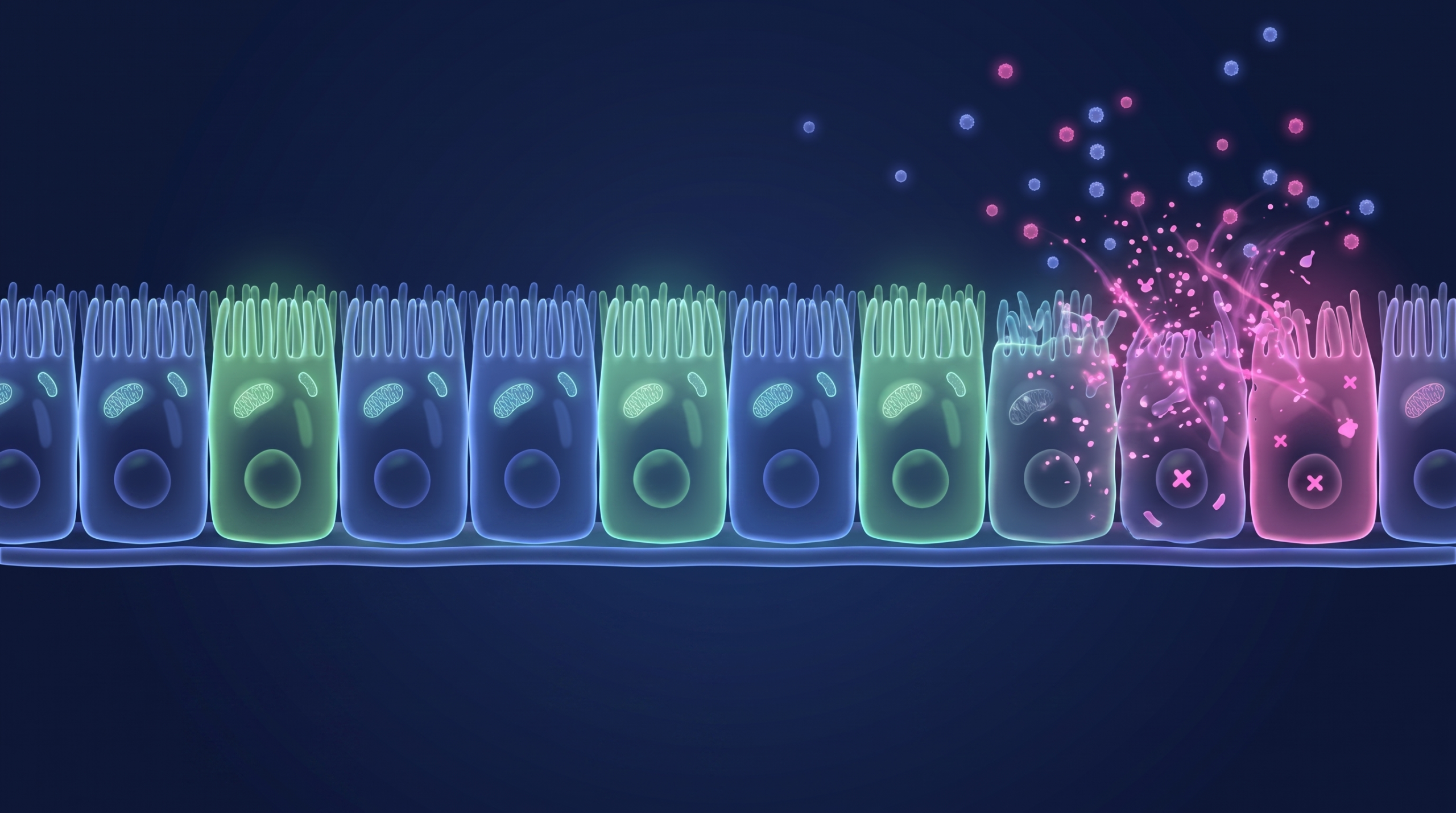
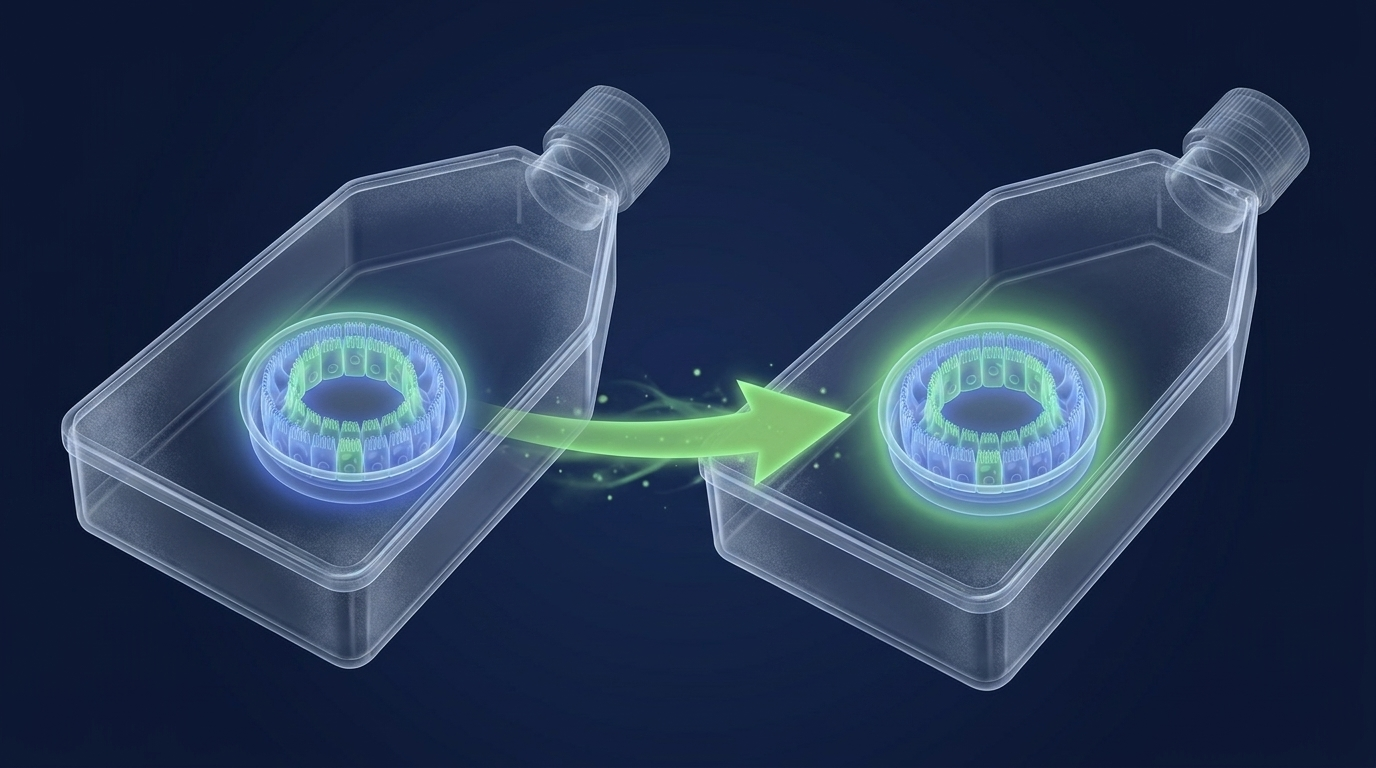
For all the sophistication in the TL1A pipeline, every one of these drugs shares a low-tech limitation. It is an antibody, and antibodies get injected. That is fine for many patients, but the irony is worth sitting with. We are building exquisitely targeted therapies for a disease of the gut. Yet we deliver almost none of them to the gut directly. Oral drug delivery in IBD remains one of the field’s stubbornly unsolved problems. It is the part of this story I keep coming back to.
Why oral drug delivery in IBD is so hard
The reason is brutal biology. The gut is built to destroy and exclude exactly the kind of large, fragile molecules that modern biologics are. Stomach acid, digestive enzymes, a mucus layer, and a tight epithelial barrier all stand between an oral antibody and its target. Swallow an antibody and you mostly just digest it. So the injectable format has held, and the near-term race is not really about going oral at all. It is about going less often.
The most realistic convenience play right now is dosing frequency. Spyre and others are engineering extended half-life TL1A antibodies aimed at subcutaneous dosing every few months. The bet is that a shot twice a year competes with a daily pill on adherence. That is a real improvement. Still, it sidesteps the delivery problem rather than solving it.
The harder, more interesting work
The work I find more interesting is the attempt to actually cross the gut, or to stay put inside it. A few threads are worth watching.
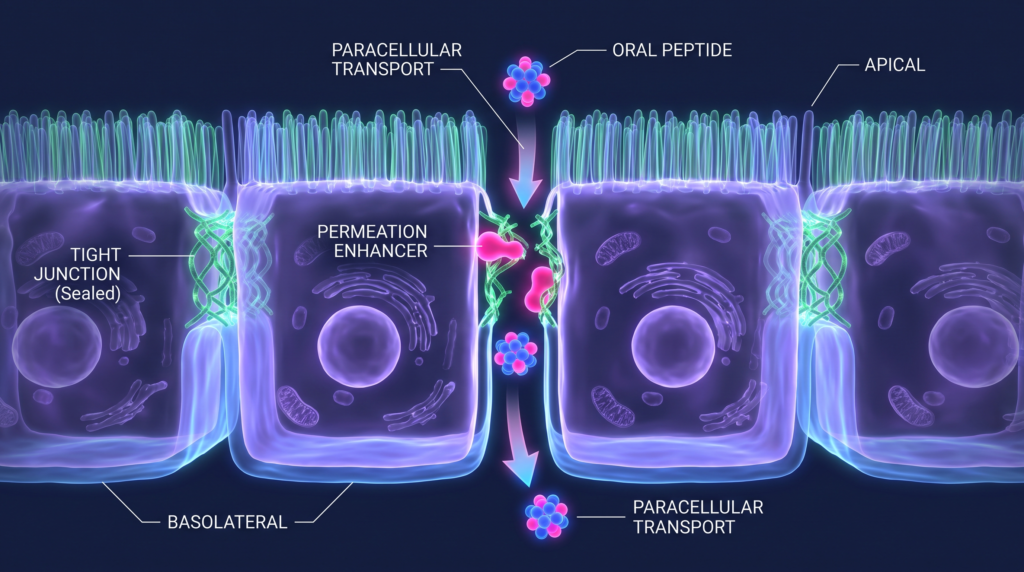
For smaller modalities, permeation enhancers like SNAC and sodium caprate transiently loosen the epithelial barrier to let peptides through. It is the same trick that made oral semaglutide possible. Formulation is also getting smarter about where a drug releases. Triastek’s 3D-printed gastric-retention tablets are designed to sit in the upper GI tract and meter a drug out slowly, a platform aimed straight at the absorption problem. A different school gives up on systemic absorption entirely. It designs gut-restricted small molecules and oral RNA that act locally in the mucosa and never reach the bloodstream. Whether any of these ever carries a molecule the size of a TL1A antibody is an open question. The direction of travel is not.
The enhancer’s second job
There is a catch a DMPK scientist learns to respect. A permeation enhancer works by perturbing the barrier, and a barrier you perturb is a barrier you can damage. The same mechanism that ushers a peptide across the epithelium can, at the wrong dose, strip or inflame it. So the question is never only how much drug gets across. It is also what the enhancer does to the tissue on the way, and whether that stays tolerable dose after dose. Regional targeting adds another layer. The small intestine and the colon are different tissues, with different absorption and different sensitivities. So a formulation tuned for one can misbehave in the other. These are not footnotes. They are the difference between a delivery technology that reaches the clinic and one that stalls in tox.
Where DMPK earns its keep
Every one of these approaches lives or dies on the same measurements. If you are enhancing permeability, you have to know how much drug actually crosses, and at what cost to the barrier. After all, the enhancer that lets your drug through can also injure the epithelium. If you are restricting a drug to the gut, you have to prove it stays there. Those are human intestinal questions, and the honest way to answer them is in human intestinal tissue. That is what we build at Altis. RepliGut® models measure permeability, absorption, and epithelial tolerability in the tissue a drug actually has to get through. A mouse gut will not tell you the truth about a human permeation enhancer. Neither will a Caco-2 monolayer, the old standby that was never built for it.
The TL1A story is, underneath everything, a story about reaching the gut with the right signal. The molecules are getting better at that. The delivery, for now, lags the biology. Closing that gap will take as much attention to how a drug moves through the gut as to what it does once it arrives. That is the less glamorous half of drug development for the gut. It is also the half I find most useful to get right.