A prodrug is a bet on timing. You take a molecule that would not survive the gut, or would never reach its target intact, and you cap it with a chemical group. Later, a specific enzyme cuts that group off and the drug wakes up. The whole design depends on the body doing that unmasking in the right place, at the right moment. Roughly one in ten approved small-molecule drugs works this way, according to a holistic analysis of approved prodrugs. So when a team asks about prodrug bioavailability, the real question is about enzymes. Which ones, where they sit, and how fast they cleave. The model most groups reach for to answer that question has the wrong enzymes, in the wrong amounts, in the wrong compartment.
Why so many programs reach for a prodrug
The appeal is easy to understand. A prodrug can rescue a molecule with poor solubility, push a compound across the blood-brain barrier, or blunt the tolerability problems of a parent drug. It often does this on a faster and cheaper path than a brand-new chemical entity, because the 505(b)(2) route can lean on studies already run for the approved parent. That combination of lower cost and shorter timeline is a major reason why the strategy keeps gaining ground.
Most of these designs share one feature: an ester bond. Ester prodrugs are popular because esters are easy to install and, in principle, easy for the body to remove. The enzymes that remove them are carboxylesterases. And this is where the design and the model start to disagree.
Two carboxylesterases, two very different addresses
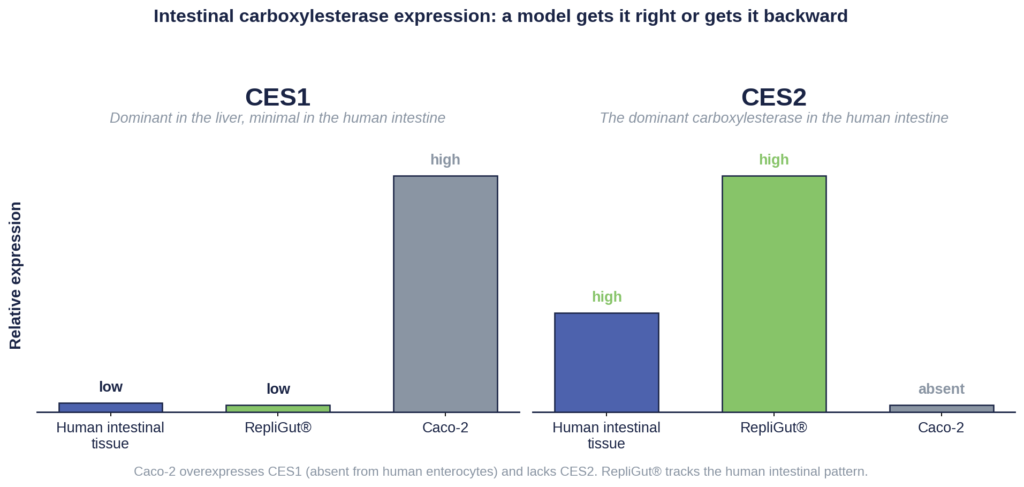
Humans carry two carboxylesterases that matter for drug metabolism, and they do not live in the same place. CES1 dominates the liver. CES2 is the predominant isoform in the human small intestine, where CES1 is barely present. That division of labor is not trivial. It is the whole basis on which many ester prodrugs are designed.
Think about what a well-behaved oral prodrug is supposed to do. It should survive the intestine intact, get absorbed, and then be activated downstream, often by CES1 in the liver. Oseltamivir is the textbook case: an ethyl ester that CES1 converts to its active form. Clopidogrel runs through CES1 as well. Other prodrugs are built as CES2 substrates and are handled right there in the gut wall, where CES2-mediated hydrolysis and intestinal transport together can hold oral exposure down, as seen with the prodrug allisartan. In every one of these cases, what happens to the drug depends on which esterase it meets first. Get the tissue esterase profile wrong and you have modeled a different drug.
The model has the esterases backward
Here is the problem. Caco-2, the colon adenocarcinoma line that became the default intestinal permeability screen, expresses CES1, which human enterocytes do not, and lacks CES2. It is the mirror image of the tissue it is supposed to stand in for.
For a cell biologist, an esterase sitting in the wrong compartment is not a rounding error. It changes the answer. A CES1-sensitive prodrug that should cross the human intestine intact gets hydrolyzed prematurely inside the Caco-2 layer. Its measured recovery drops and its apparent permeability reads low. A compound that is genuinely well absorbed can look like a poor one. Run a CES2 substrate through the same system and the opposite risk appears. The enzyme that would act in real gut tissue is missing, so intestinal handling goes unseen and stability gets overstated. Either way, the number you carry forward is wrong. Worse, it is wrong in a way that is easy to miss, because the assay itself ran cleanly.
The field already knows this is a liability. Groups have gone to the trouble of engineering Caco-2 subclones with the CES1 turned down to something closer to human small intestine, precisely so ester-containing compounds can be studied without the artifact. That is a telling amount of effort to spend patching a model. It is worth asking why the starting point sits so far from human biology in the first place.
Where prodrug bioavailability gets decided
The place this bites hardest is the Biopharmaceutics Classification System. BCS class is set in part by permeability, and permeability is exactly what the esterase artifact distorts. A prodrug that is moderately or well absorbed in people can be pushed into a lower class by premature hydrolysis. The model simply cleaves it in the wrong place. That misclassification then ripples outward into formulation choices, biowaiver decisions, and how candidates get rank-ordered against each other. The cost is not one bad data point. It is a decision made with confidence on a number that never reflected human intestinal biology.
| Caco-2 | Human small intestine | RepliGut® Planar | |
|---|---|---|---|
| CES1 (liver-type esterase) | High, not physiological | Minimal | Minimal, matches tissue |
| CES2 (gut-type esterase) | Low to absent | Dominant isoform | Expressed, tracks tissue |
| Ester prodrug handling | Premature or misplaced hydrolysis | Physiological | Physiological |
| Risk to the readout | Distorted permeability, recovery, BCS class | Reference | Human-relevant readout |
What a human intestinal model is for
None of this is an argument that carboxylesterases are exotic or that anyone did the chemistry wrong. It is an argument about the substrate you test on. If the activation and stability of an ester prodrug hinge on which esterase it meets in the gut, then the gut model has to carry the human esterase profile, or the experiment is answering the wrong question.
That is the biology RepliGut® Planar is built to reproduce. It is grown from primary human intestinal stem cells rather than a tumor line. So it expresses drug-metabolizing enzymes, including the carboxylesterases, at levels that track native human intestine: CES2 present, CES1 low. For an ester prodrug, that matters directly. The hydrolysis you measure is the hydrolysis that would happen in a person, not an artifact of a model built decades ago for a different job. It also lets you read apparent permeability and first-pass intestinal metabolism on the same human-relevant tissue. That is the foundation of our broader in vitro DMPK and ADME work.
The regulatory wind is at this idea’s back. The FDA’s push toward new approach methodologies is, at its core, a push toward models that predict human outcomes because they are built from human biology. For prodrugs, the entire strategy rests on controlled, tissue-specific activation. So this is not a philosophical preference. It is the difference between a prodrug bioavailability number you can build a program on and one you cannot.
If you are working on an ester prodrug, watching it behave on human intestinal tissue rather than a cancer line with the wrong esterases is a study worth running early. It is also one of the harder problems in oral delivery. In fact, why the gut resists so many oral drugs is a theme we keep coming back to. The measurement is only ever as honest as the tissue underneath it.