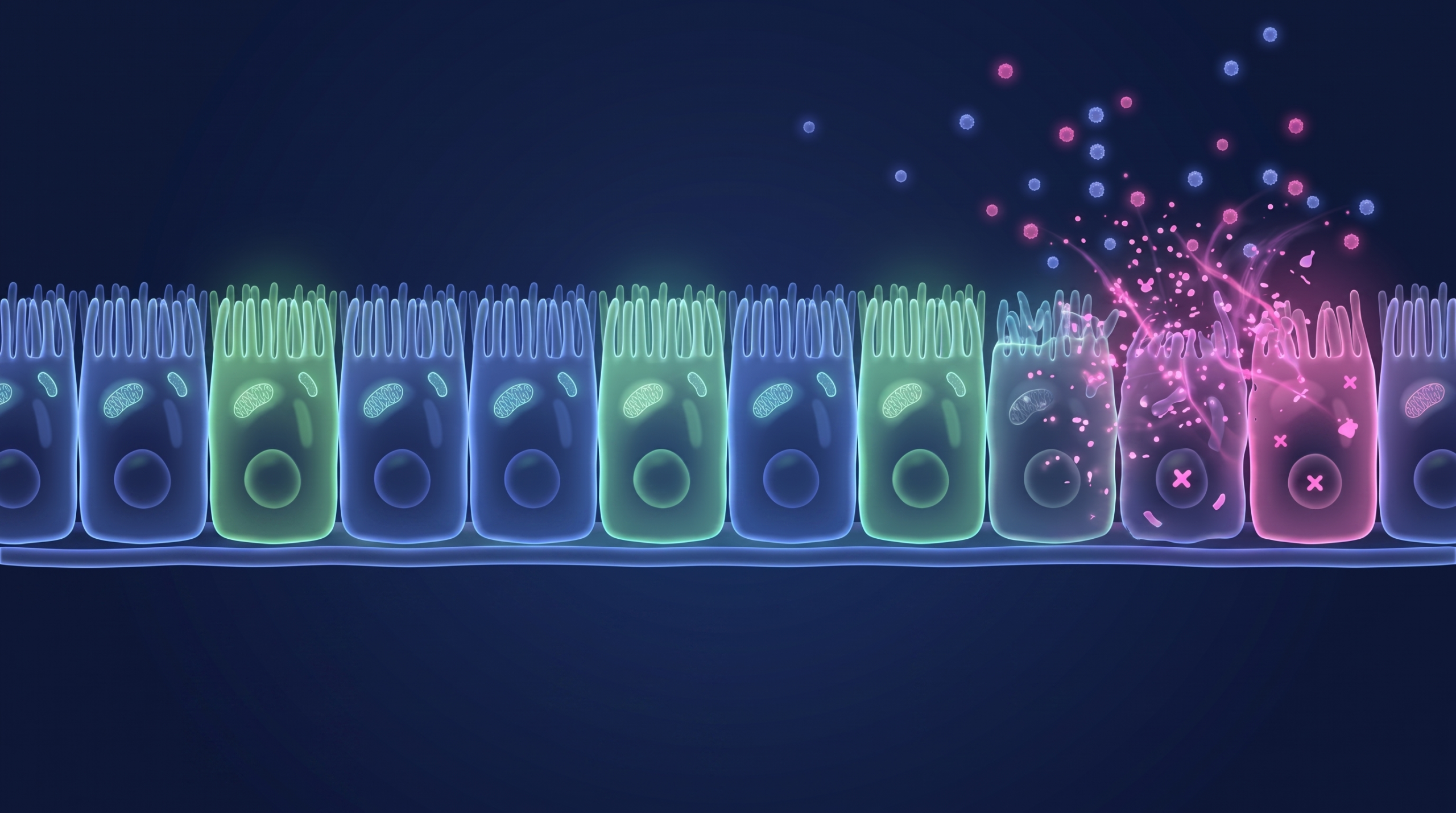
Inflammatory bowel disease has a stubborn ceiling. Even the best biologics put only a minority of patients into durable, steroid-free remission. And every new mechanism eventually plateaus at a similar wall. That is the problem TL1A bispecific antibodies are built to solve. Instead of blocking one node in the inflammatory cascade, they engage two at once. The pairing that has captured the field is TL1A with IL-23. It is the most interesting bet in gut immunology right now. It is also a master class in how hard it is to turn an elegant mechanism into a drug.
Why pair TL1A with IL-23
The rationale is mechanistically clean, which is a large part of the appeal. IL-23 sustains the pathogenic Th17 program that drives chronic intestinal inflammation. TL1A, signaling through its receptor DR3, costimulates effector T cells and, distinctively, drives fibrosis in the gut wall. Both sit upstream in the immune cascade, and they act on overlapping populations of mucosal immune cells. Hit either one alone and you quiet part of the response. Hit both, and preclinical models suggest you reduce disease activity more than either target achieves on its own.
Want the fuller story on why TL1A itself has become the most sought-after target in the gut? See our overview of TL1A in IBD. The short version: it is an upstream, context-restricted regulator with human genetic validation. It also has a rare dual role in both inflammation and fibrosis. Layering IL-23 blockade on top is an attempt to convert that biology into best-in-market efficacy.
The program landscape
The monospecific TL1A antibodies are still the ones with Phase 3 data, but the bispecific race is filling in fast. Several distinct engineering strategies are now in or near the clinic.
| Program | Company | Targets | Notable angle |
|---|---|---|---|
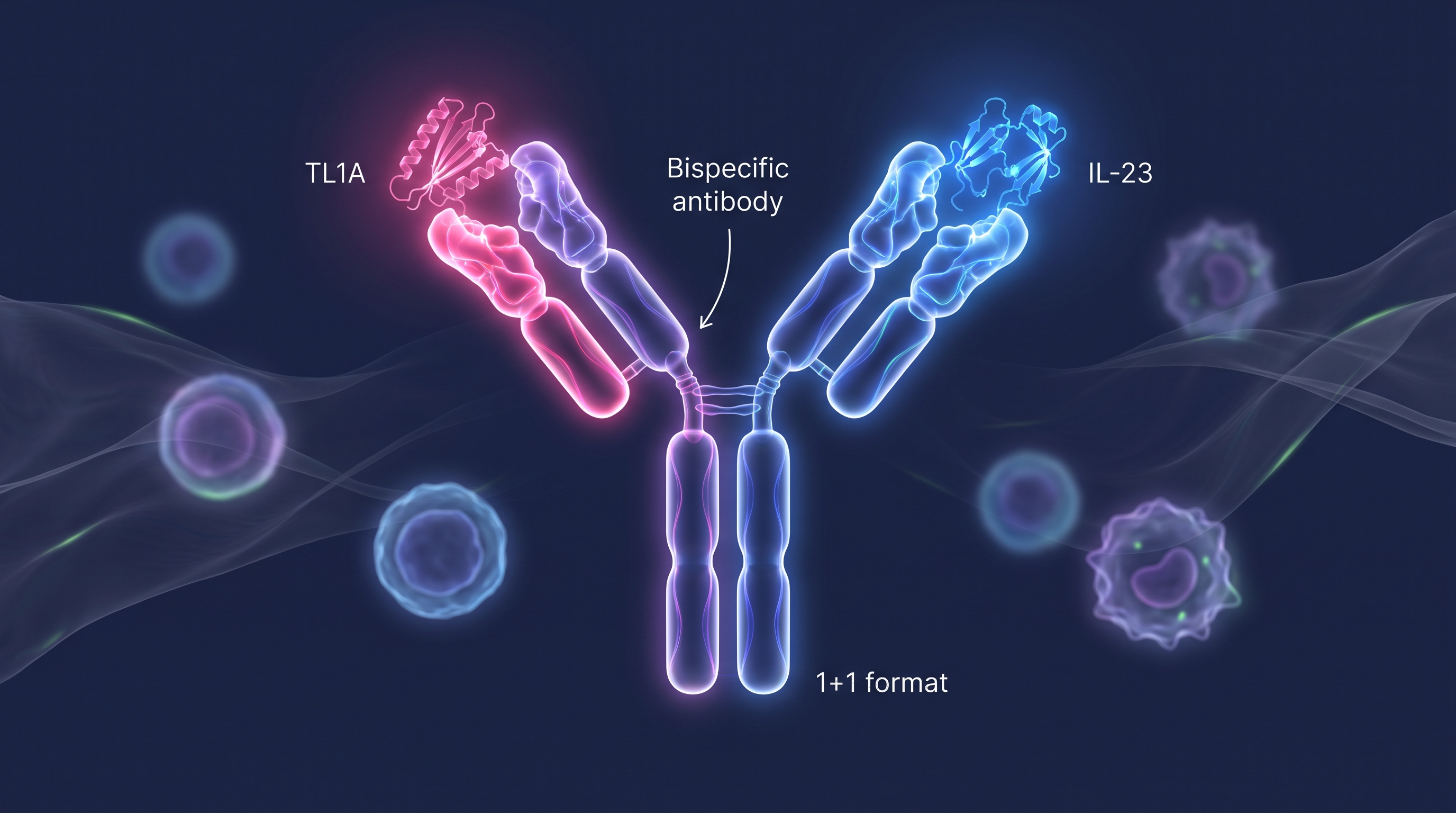
| XmAb412 | Xencor | TL1A x IL-23p19 | Native-like 1+1 format designed to avoid immune complexes |
| RO7837195 | Roche (Pfizer origin) | TL1A x IL-23 | Phase 2 in IBD |
| CLD-423 | Caldera Therapeutics | TL1A x IL-23 | First subjects dosed in Phase 1, conditionally active design |
| SL-846 | Shattuck Labs | DR3 x IL-23R | Engages the TL1A receptor (DR3) rather than the soluble ligand |
A few programs work the same pathway from the other side, engaging the TL1A receptor DR3 rather than soluble TL1A. Others are close behind, including Ailux’s ALX001, and Teva has signaled it is engineering its own TL1A bispecific. The point is not any single asset. The bigger point is timing. Within a couple of years, the dual TL1A and IL-23 concept has gone from a poster to a crowded, well-capitalized field. That only happens when the underlying logic is hard to argue with.
The engineering problem hiding underneath
Here is where the story gets more instructive than a pipeline table can convey. Bispecific antibodies are not just two drugs glued together. Format matters enormously, and TL1A has already taught the field a painful lesson about it.
Early TL1A-directed molecules ran into near-universal anti-drug antibodies. Amgen’s AMG966 was discontinued after immunogenicity problems, and the mechanism turned out to be revealing. The drug and its soluble target formed large immune complexes that broke tolerance. That provoked an antibody response against both the drug and TL1A itself. A conventional 2+2 bispecific has two binding arms per target. So it can cross-link soluble ligands into exactly the kind of lattice that triggers this response.
That is why the newer entrants obsess over format. Xencor’s XmAb412 uses a native-like 1+1 design, one arm per target. The goal is to bind with high affinity while avoiding the immune-complex lattice that sank earlier candidates. The engineering goal is no longer just potency. It is potency without the immunogenicity that quietly kills a program in Phase 1. So any read of this class treats immunogenicity as a first-order design constraint, not a footnote. The anti-drug-antibody question deserves its own discussion, which we take up in a companion piece on anti-drug antibodies in IBD.
Format is not the only axis of the race. Many of these molecules also carry half-life extension engineering, aimed at subcutaneous dosing every eight to twelve weeks or longer. The theory is that convenience will help a new mechanism win share from entrenched biologics. A molecule that is both cleaner on immunogenicity and easier to dose is the profile everyone is chasing.
The open questions
Even the basic pharmacology carries unknowns. The optimal ratio of TL1A to IL-23 inhibition in human disease is not defined. So a fixed-ratio bispecific is a bet that one stoichiometry fits most patients. It might. It might also turn out that flexibility matters, and that co-formulated or combination approaches have a role. The field does not yet know. And that uncertainty is precisely why the next few years of readouts will be worth watching closely.
Why this needs human models
A dual-pathway molecule whose entire premise is synergy cannot be evaluated in a monoculture. TL1A and IL-23 act at the interface of immune cells, epithelium, and stroma. The effects that matter only appear when those compartments are together in the same system. Think calming the fibrotic loop, shifting cytokine output, avoiding immune-complex formation. Mouse models miss much of the human-specific biology. And a dish of one cell type misses the crosstalk that is the whole point.
That is why we build human immune co-culture models at Altis, on the RepliGut® platform. Reading how a TL1A bispecific behaves against human models of intestinal inflammation, with real epithelium, immune cells, and stromal signals in play, is the test. That is how you separate an elegant mechanism from a drug that will actually break the ceiling. The molecules are getting more sophisticated. The systems we test them in have to keep up.